The U.S. Carbine Caliber .30 | ||
 | ||
Home | ||
|
|
|


|
Mission StatementTo provide a visual reference of the U.S. Carbines, Caliber .30, their variations, parts, accessories and more. To assist and encourage new owners, old owners, collectors and researchers to share and exchange information for the purpose of expanding everyone's knowledge. To facilitate communication with one another to collectively further the mutual goals of learning, preserving and sharing the history of the U.S. Carbines, Caliber .30.
IntroductionWork on this website has been ongoing since the summer of 2015. The information and photographs herein have been the fruits of years of research. Without the collective work and cooperation of many this website and it's forum could not have happened. The website is an ongoing project. Some pages now under construction will be completed over the next few months. It is hoped the website will expand to include additional material, including accessories, magazines, ammunition and more. One of the many goals of the forum is provide a means by which research and knowledge can be pooled. Then shared via the website. Please feel free to jump in on the forum and help make this endeavor grow.
General Overview
| |||||||||||||||||||||||||||||||||||||||||||||||||||||||||||||||||||||||||||||||||||||||||||||||||||||
 "The pistol and revolver being primarily defensive weapons it was the desire of the U.S. Forces to equip the soldier normally armed with these weapons with one having more offensive characteristics. It was
thought desirable to extend the range on the proposed weapon to at least 300 yards, thus increasing the effectiveness of the soldier armed with sidearm's by at least 200 yards."
"The pistol and revolver being primarily defensive weapons it was the desire of the U.S. Forces to equip the soldier normally armed with these weapons with one having more offensive characteristics. It was
thought desirable to extend the range on the proposed weapon to at least 300 yards, thus increasing the effectiveness of the soldier armed with sidearm's by at least 200 yards."
similar to that of the commercial Winchester self-loading cartridge, caliber .32 |
The deadline set for submissions was May 1941. ["Proving Ground History of the Carbine, Caliber .30 M1" by Major G.P. Grant, U.S. Army Ordnance Dept., 30 Sep 1944]
Winchester's Light Rifle Submission
Winchester initially decided against an entry due to existing commitments. The deadline had already passed with trials underway when Winchester contacted Ordnance to advise them of developments during the design of a different project that had convinced Winchester they may be able to come up with a submission for the light rifle trials. The poor performance of submissions during the current trials caused Ordnance to give Winchester the go-a-head, if Winchester could produce a submission before the end of the current trials.
Thirteen days later, 09 Aug 1941, Winchester presented their first prototype to the Ordnance Department for preliminary testing. The tests revealed the need for a number of improvements. Winchester presented their second prototype to the Ordnance Department on 14 Sep 1941 for the second round of testing. At the completion of the tests the Winchester light rifle was adopted as the Carbine Caliber .30, M1 on 30 Sep 1941.
Winchester had designed and produced the winning submission in seven weeks.

Winchester's other commitments caused Ordnance to enlist the assistance of the Inland Division of General Motors for further improvements to the design. After the production of a number of prototypes and changes to various parts, Inland produced the first carbines in June 1942, less than a year after Winchester had started the design and less than two years since Ordnance's call for submissions.
Production
Between June 1942 and August 1945 ten primary U.S. contractors manufactured over 6 million U.S. .30 Caliber Model M1, M1A1, T4, M2, T3, and M3 Carbines. To date, no other firearm manufactured in any country has surpassed the quantity of U.S. 30 Caliber Carbines manufactured during their 38 months of production. Even more amazing is only one of these contractors, Winchester, had the machinery, tooling and experience of manufacturing firearms prior to the carbines.
| Manufacturer | First Production | End Production | Total Production | # Months |
| Inland Manufacturing Division, General Motors Dayton, OH | June 1942 | August 1945 | 2,632,097 | 38+ |
| Winchester Repeating Arms New Haven, CT | September 1942 | August 1945 | 828,059 | 35+ |
| Underwood Elliott Fisher Company Hartford, CT | November 1942 | April 1944 | 545,616 | 17 |
| Rock-Ola Manufacturing Chicago, IL | November 1942 | May 1944 | 228,500 | 18 |
| Irwin-Pedersen Arms Grand Rapids, MI | January 1943 | March 1943 | 0* | 3 |
| Quality Hardware & Machine Chicago, IL | February 1943 | April 1944 | 359,666 | 14 |
| National Postal Meter Rochester, NY | February 1943 | April 1944** | 413,017 | 14 |
| Standard Products Port Clinton, OH | April 1943 | April 1944** | 247,160 | 12 |
| Saginaw Steering Gear, General Motors Saginaw, MI | May 1943 | April 1944 | 293,592 | 11 |
| Saginaw Steering Gear, General Motors Grand Rapids, MI | May 1943 | January 1944 | 223,620 | 9 |
| I.B.M. Poughkeepsie, NY | August 1943 | May 1944 | 346,500 | 10 |
| Totals: | June 1942 | August 1945 | 6,117,827 | 38+ |
|
+: months shown are months of actual production. Several dozen carbines (included in the totals) were produced as prototypes before full production started | ||||
|
*: all 3,542 carbines produced by Irwin-Pedersen failed to pass Ordnance inspection. Their contract and facility was turned over to Saginaw Steering Gear who disassembled the carbines, inspected each part, and integrated the surviving Irwin-Pedersen parts and receivers into the production of carbines produced by Saginaw at Grand Rapids. | ||||
|
**: After their contracts ended National Postal Meter as Commercial Controls completed 239 carbines and Standard Products completed 150 carbines for U.S. Army Ordnance | ||||
Many original records were lost or destroyed after WWII. No single reliable source has been found for production totals and months of manufacture. As you will see throughout this website a fair amount of what we now know has been provided by the years of research of many, who have cooperated and shared with one another. Research is still ongoing by a number of researchers and it is hoped this website and it's forum will serve as a means to foster cooperation, sharing and further research in an effort to better understand and preserve the history of the U.S. Carbines Caliber .30.
During World War II these carbines were issued to U.S. soldiers in every theater of war around the world.
U.S. Carbines were also supplied to a number of Allies via the Lend/Lease Program during WWII.
Carbines were smuggled or parachuted to resistance groups in a number of different countries during the war.

Post WWII
After the end of WWII many of the carbines were returned to America where they were inspected, refurbished, and/or rebuilt to the latest standards. Many of the carbines did not return to America. Instead, they were stockpiled in various countries in case they were needed.
With the onset of the Korean War in 1950 the U.S. .30 Caliber Carbines once again served American troops and America's Allies. However, during this war the decision was made to offer the .30 Caliber Carbines as a main battle rifle, a role it was not designed or suited for. It's not surprising the carbines used in Korea received a reputation as less than adequate, particularly during the Korean winters when almost every American small arm had problems functioning. They fared better in urban areas as an alternative to a handgun at distances of less than 300 yards. This was the same reason they would later become popular with police departments around the world.
After the end of the Korean War many of the carbines were once again returned to America, where they were inspected, refurbished, and/or rebuilt to the latest standards. Once again, carbines were also stockpiled in various countries in case they were needed.
Of the over 6 million carbines built, over half were at some point provided or sold to other nations as military assistance. Many of these nations sold part or all of their carbines to other countries around the world.
Obsolescence?
After the war in Korea, with the overwhelming influx of military hardware returning to Ordnance facilities throughout the U.S.A. many rifles stateside were declared as surplus by U.S. Army Ordnance 1957-1958. Much of this surplus was sold at various arsenals and armories throughout the country. Some of the material was rendered inoperable and sold to scrap metal companies. Ordnance also auctioned many small arms parts to civilian companies. The U.S. .30 Caliber Carbines were never officially declared obsolete with many continuing to serve through the War in Vietnam and U.S. Air Force security personnel worldwide through the 1970's.
Since the early 1960's private companies, importers and exporters have acquired a great many of these carbines and their parts. These have been sold and traded throughout the U.S.A. and abroad to the military, police, and civilians of various countries. The quantity of inexpensive surplus parts, lack of receivers, and popularity of the carbines with citizens and civilian police agencies has motivated over thirty different companies to produce over a million additional carbines since 1960 with commercially produced carbines and parts still being manufactured today.
Through the Director of Civilian Marksmanship (eventually becoming today's Civilian Marksmanship Program) the U.S. Army has provided thousands of carbines for raising funds to support shooting programs across the nation.
Into the 21st Century
| In the words of author Ken Warner in the 21st edition of Gun Digest in 1967, "Why Won't The GI Carbine Die? Nobody likes this little rifle but people, that's why...". True today as it was in 1967.
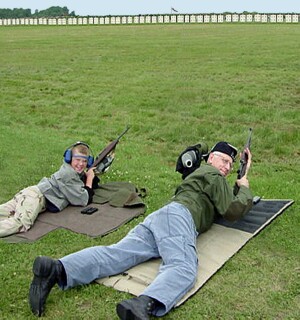
The popularity of these carbines has led many to buy one for home protection and/or recreational shooting. Collectors are in no short supply. Since the addition in August 2006 of an M1 Carbine Match to the National Matches held yearly at Camp Perry, OH, the Civilian Marksmanship Program (CMP) has added the match to their regional competitions nationwide. Carbines continue to be used by film makers in documentaries, war movies, science fiction, on television and in video games. If you are one of these people, or intend on becoming a carbine owner, this website is for you. The information provided here is basic to intermediate. Resources for additional information may be found throughout the website, on the pages devoted to Links and Books, and on the discussion forums indicated at the bottom of each page. |
 |
|
|
Worth Noting
Don't make the mistake of forgetting the history of these carbines and all they've been through. If a carbine looks like new, someone may have reconstructed it into something it isn't, which is a hobby for some people and a profession for others. Stories of where the carbine was used should be substantiated by documentation, without which it would be wise not to accept the stories at face value. One of the most common stories is "this carbine went up the beaches on D-Day with my wife's grandpa (or other relative) who snuck it home in his duffel bag at the end of WWII, and kept in the closet since then". A few did come back this way, but far less than some people would want you to believe.
|
|
Should you have questions, assistance is available on our Discussion Forum.

|
The Discussion Forum also serves as a reference desk for the more advanced material that could easily overwhelm a website and is often subject to opinions that may vary due to a lack of original documentation. A number of researchers and authors are present on the forums, helping others and seeking information for various research projects.
|
|
© Copyright 2012- The Carbine Collectors Club. All Rights Reserved.